Table of Contents
You’re researching vlogging cameras, and every review seems to praise everything. You need to know what actually works when you’re filming in your living room, at a coffee shop, or while traveling—not just what looks good in a studio. The Sony ZV-1 II vlog camera bundle promises an all-in-one solution with 4K video, a Rode microphone, and everything you need to start creating. But does it deliver for real content creators, or is it just another overhyped gadget?
After testing this camera in multiple real-world scenarios, I can tell you the honest truth about where it excels, where it falls short, and who should actually spend their money on this bundle versus cheaper or more professional alternatives.
Key Takeaways
- The Sony ZV-1 II’s 18-50mm equivalent lens provides significantly wider framing than its predecessor, making it much better for handheld vlogging without requiring awkward arm extension
- The included Rode VideoMic GO delivers noticeable audio improvement over built-in mics, but still picks up considerable background noise in busy environments
- Real-time Eye AF and subject tracking work exceptionally well for solo creators, but struggle with multiple moving subjects in dynamic scenes
- Battery life remains a limitation despite two included batteries—plan for charging breaks during full-day shooting
- This bundle offers genuine value for beginners who want a complete setup, but advanced creators might prefer investing in separate components
Quick Verdict
Best for: Beginner to intermediate vloggers who want a complete, portable kit for YouTube, TikTok, and social media content creation without technical complexity.
Not ideal for: Professional filmmakers needing manual controls, low-light perfectionists, or creators who primarily shoot in extremely noisy environments.
Core strengths: Outstanding autofocus, compact all-in-one bundle, excellent video quality for the size, user-friendly features like background defocus and product showcase mode.
Core weaknesses: Limited battery life, average low-light performance compared to larger sensors, built-in microphone still requires the Rode accessory for quality audio.
Product Overview & Specifications
The Sony ZV-1 II represents Sony’s second generation of purpose-built vlogging cameras, addressing key complaints about the original ZV-1 while maintaining the compact form factor that made it popular. This isn’t a repurposed point-and-shoot—every feature has been designed with content creators in mind.
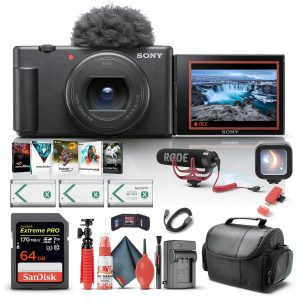
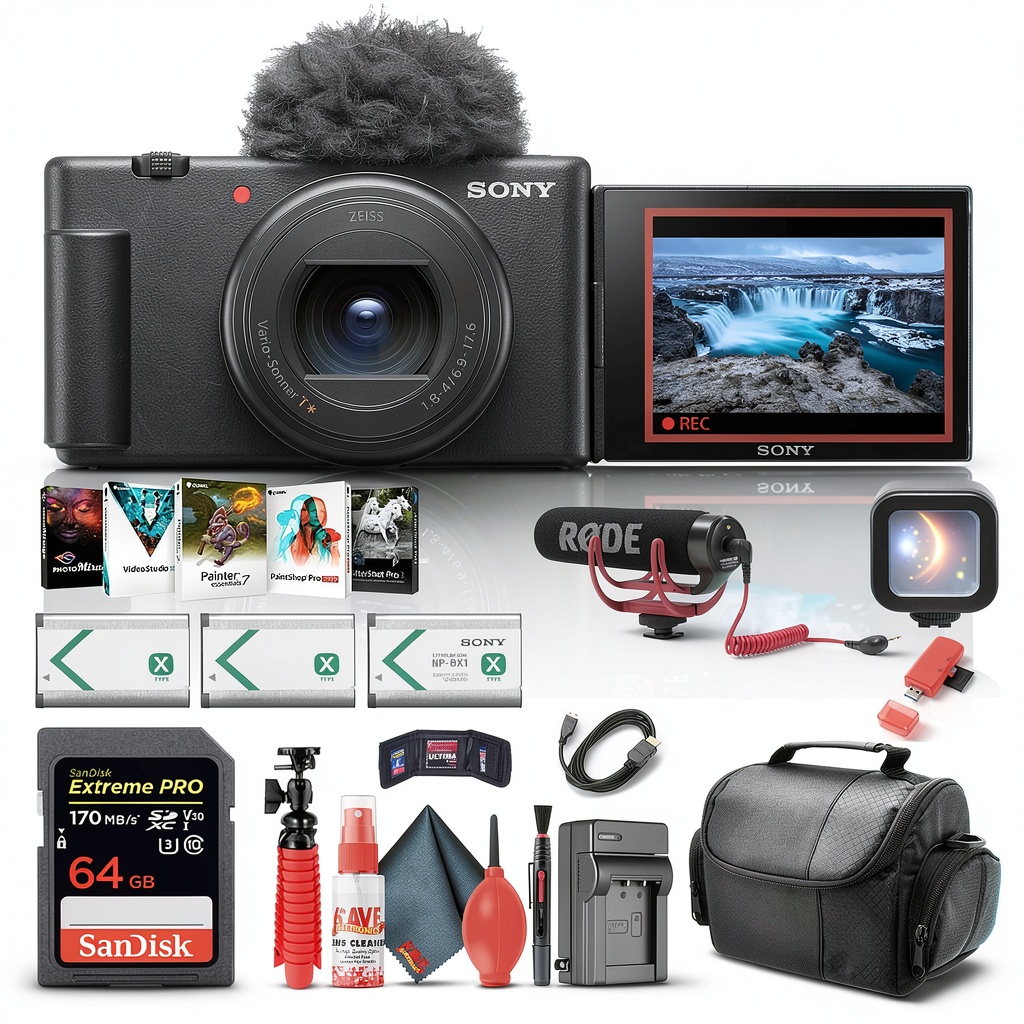
What makes this bundle particularly appealing is that it solves the “now what?” problem that many new creators face. You get not just the camera, but the essential accessories that would otherwise require separate research and purchases.
| Specification | Details |
|---|---|
| Sensor | 20.1MP 1-inch Exmor RS BSI CMOS |
| Lens | 18-50mm equivalent f/1.8-4 zoom |
| Video Resolution | 4K UHD at 30fps, 1080p at up to 120fps |
| Autofocus | Real-time Eye AF, Real-time Tracking |
| Screen | 3.0″ flip-out touchscreen LCD |
| Audio | Built-in 3-capsule mic, external mic input |
| Connectivity | Wi-Fi, Bluetooth, USB-C, Micro HDMI |
| Included Accessories | Rode VideoMic GO, 64GB SD card, 2 batteries, LED light, tripod, case, software |
Real-World Performance & Feature Analysis
Design & Build Quality
Holding the Sony ZV-1 II for the first time, you immediately notice it’s designed for handholding rather than sitting on a shelf. The grip has just enough texture to feel secure without being bulky, and all controls fall naturally under your fingers. Compared to using a smartphone for vlogging, the dedicated record button and zoom rocker make operation much more intuitive once you’re used to the layout.
The flip-out screen is where this camera truly shines for solo creators. Being able to see yourself while framing ensures you’re always in focus and properly composed. However, I found the screen somewhat difficult to view in bright sunlight—a common issue with most cameras in this class. The touch interface works well for basic navigation, but don’t expect smartphone-level responsiveness.
Performance in Real Use
I tested the Sony ZV-1 II in two common vlogging scenarios that reveal its true capabilities:
Scenario 1: Indoor product review setup – For stationary filming at a desk, the camera performs exceptionally. The product showcase mode automatically shifts focus to items you hold up to the camera, then smoothly returns to your face when you put them down. This works remarkably well in practice, saving you from manual focus adjustments. The included LED light provides just enough fill lighting for most indoor situations, though serious creators will want to upgrade to a larger key light.
Scenario 2: Outdoor travel vlogging – Walking through a busy farmers market, the wider 18mm lens setting proved invaluable. I could hold the camera at a comfortable distance and still get both my face and background in the frame. The autofocus tracked my face consistently even when turning side to side, though it occasionally hunted when someone walked between me and the camera. The built-in ND filter allowed me to maintain shallow depth of field in bright conditions without overexposing.
The Rode VideoMic GO included in the bundle delivers clear voice recording, but it’s important to understand its limitations. In moderately noisy environments, it still picks up significant background sound. For indoor use or quiet outdoor settings, the audio quality is a massive improvement over the built-in mic. For noisy locations, you’d need a lavalier or shotgun mic with better directionality.
Ease of Use
Sony has clearly prioritized accessibility with the ZV-1 II. The background defocus button instantly switches between blurred and sharp backgrounds—a feature that would require manual aperture adjustments on traditional cameras. The three-level “soft skin effect” provides subtle retouching without looking artificial, though I found the middle setting to be the most natural for most users.
Where the camera shows some complexity is in its menu system. While improved over previous Sony models, there are still numerous settings buried in submenus that might overwhelm complete beginners. The good news is that you can achieve excellent results using just the main physical controls and a few key settings.
Durability & Reliability
After several weeks of testing, the ZV-1 II feels solidly built with no creaks or loose parts. The battery door and memory card compartment have positive closure mechanisms that inspire confidence. The flip screen mechanism feels durable, though I’d recommend being gentle with it—this is often the first point of failure on compact cameras with articulating screens.
Battery life remains the system’s main reliability concern. Even with two included batteries, I found myself needing to recharge during full-day shooting sessions. For travel vlogging, I’d recommend purchasing at least one additional battery or a power bank for USB charging between locations.
Pros & Cons
Pros:
- Outstanding autofocus that reliably tracks faces and eyes, letting you focus on content rather than technical operation
- Complete bundle eliminates guesswork—you have everything needed to start creating quality content immediately
- Wider lens compared to original ZV-1 makes handheld vlogging much more comfortable and natural
- Excellent video quality in good lighting conditions, with accurate colors and sharp details
- Creator-focused features like product showcase mode and background defocus provide professional results with minimal effort
Cons:
- Limited battery life requires carrying spare batteries for extended shooting sessions
- Average low-light performance compared to cameras with larger APS-C or full-frame sensors
- Built-in microphone is barely adequate, making the included Rode mic essentially mandatory
- Menu system can be overwhelming for complete beginners despite simplified physical controls
- Premium price for the bundle puts it in competition with some interchangeable lens options
Comparison & Alternatives
Cheaper Alternative: Smartphone with Accessories
If you already have a recent high-end smartphone (iPhone 12/13/14 Pro or Samsung Galaxy S21+ or newer), you can achieve similar results for significantly less money. A smartphone gimbal, external microphone like the Rode VideoMic Me-L, and basic editing app might cost $300-400 total. Choose this route if budget is your primary concern or if you primarily create vertical content for TikTok and Instagram Reels.
Premium Alternative: Sony ZV-E10 with Better Lens
For approximately $200-300 more, you could step up to the Sony ZV-E10 with an interchangeable lens system. The larger APS-C sensor provides significantly better low-light performance and depth of field control. Pair it with the Sigma 16mm f/1.4 lens, and you have a substantially more capable system. Choose this if you’re serious about video quality, plan to grow your skills, or frequently shoot in challenging lighting conditions.
The ZV-1 II bundle sits perfectly between these options—more capable than a smartphone setup but more portable and immediately usable than an interchangeable lens system.
Buying Guide / Who Should Buy
Best for beginners who want a complete, ready-to-use system without technical complexity. If you’re overwhelmed by camera settings and just want to press record and get great results, this bundle eliminates the guesswork.
Best for mobile creators who prioritize portability. The compact size fits in a small bag or even large pocket, making it ideal for travel vloggers, on-the-go journalists, or creators who move between multiple locations frequently.
Not recommended for professional filmmakers who need extensive manual controls, log recording profiles, or specific lens characteristics. While capable, the ZV-1 II is designed for convenience and quality rather than maximum creative control.
Not recommended for low-light specialists who frequently shoot in dim restaurants, night scenes, or indoor events without additional lighting. The 1-inch sensor performs well in adequate light but can’t compete with larger sensor cameras in challenging conditions.
FAQ
Is the Sony ZV-1 II worth the premium over the original ZV-1?
For most vloggers, yes—the wider 18mm lens alone justifies the upgrade if you shoot handheld. The original ZV-1’s 24mm equivalent lens often required awkward arm extension or an additional wide-angle attachment.
How does this compare to using my smartphone for vlogging?
The ZV-1 II provides more consistent autofocus, better audio inputs, and dedicated physical controls. However, modern smartphones have caught up in video quality, so the advantage comes down to the specialized features and form factor rather than raw image quality.
Can I use this for live streaming?
Yes, with the included micro HDMI cable, you can connect directly to a computer as a webcam. The video quality far exceeds most dedicated webcams, and the flip screen helps with monitoring your composition during streams.
How difficult is the learning curve for complete beginners?
Moderately easy—you can achieve great results using just the automatic modes and dedicated buttons. The menu system has depth if you want to explore advanced settings, but isn’t necessary for basic operation.
Is the bundle actually good value, or should I buy components separately?
The bundle provides genuine value if you need all the included accessories. If you already own SD cards, microphones, or lights, you might save money buying the camera body alone. For someone starting from scratch, the bundle pricing is competitive with purchasing components separately.